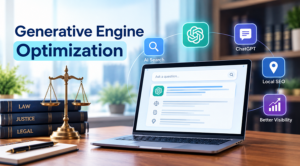


If someone gets into a car accident today, there’s a good chance they won’t start their search on Google. They’ll open ChatGPT, Gemini, or Perplexity and type something like “do I need a lawyer after a car accident” or “best personal injury attorney near me.” The answer that AI tool gives back is now doing the job that the top three Google results used to do. That’s the short version of what’s changing. The longer version is that personal injury law firm marketing has to account for how these AI systems pull, summarize, and cite information — not just how Google’s blue links rank.
This isn’t a small shift. It’s a rewrite of the rulebook. And firms that treat this as “SEO but with extra steps” are going to fall behind firms that actually understand how answer engines choose what to feature.
Why AI Search Changes the Game for Personal Injury Firms
AI search tools don’t rank ten blue links. They read a handful of sources, pull out the parts that answer the question, and hand the user a summary — often with one or two links attached. If your firm’s website isn’t one of those sources, you’re invisible in that moment, no matter how well you rank in traditional search.
This matters even more for personal injury cases because these searches happen at moments of stress. Someone hurt in a crash, hurt at work, or dealing with a slip-and-fall wants a fast, trustworthy answer — not ten tabs to compare. AI tools are built to serve exactly that kind of urgency. Personal injury law firm marketing that ignores this shift is marketing to a search behavior that’s already fading.
Want the full strategy? Check out our Personal Injury Law Firm Marketing Playbook.
How AI Tools Decide Which Law Firms to Mention
AI models don’t guess. They pull from content that’s structured, factual, and easy to extract. A few things consistently show up in the sources these tools cite:
- Clear, direct answers near the top of a page — not buried under three paragraphs of introduction
- Content organized with real headings and subheadings, not one long block of text
- Specific numbers, timelines, and process details (how long a claim typically takes, what documentation is needed)
- Author or firm credentials that establish real experience with personal injury cases
- Consistent information across your website, Google Business Profile, and third-party listings
This is where SGEO for law firms comes in — search generative engine optimization is built around exactly these signals. It’s not a replacement for SEO; it works alongside it, but it puts more weight on structure, clarity, and factual accuracy than on keyword density alone.
Answer Engine Optimization: The New Foundation of Personal Injury Law Firm Marketing

Answer engine optimization for law firms starts with a simple idea: write to answer the question, not to rank for the phrase. If a potential client asks “how much is my personal injury case worth,” your page should answer that directly in the first few sentences, then expand with context, ranges, and factors that affect value.
This approach does double duty. It helps AI tools pull your content as a source, and it helps human readers get what they came for without wading through fluff. Google’s recent updates have leaned harder into rewarding content that’s genuinely helpful for people in search results — not content written to game a system. Personal injury law firm marketing built on real answers to real questions holds up under both standards.
A few practical formats that work well here:
- FAQ sections written in plain, conversational language
- Short, scannable answers followed by deeper explanation. For a step-by-step breakdown, see how lawyers can rank in AI answers.
- Process breakdowns (what happens after you file a claim, step by step)
- Local specifics — court names, state deadlines, filing requirements
Why Your Website Design Still Matters
Content structure gets a firm noticed by AI tools, but the site still has to hold up once a visitor clicks through. A law firm website design agency that understands personal injury marketing will build pages that load fast, read clearly on mobile, and guide visitors toward taking action — not just toward more reading.
Slow pages, cluttered layouts, and confusing navigation hurt you in two ways: users bounce, and AI crawlers struggle to parse your content cleanly. Both problems shrink your visibility. A site built with clean HTML structure, proper heading hierarchy, and fast load times gives both humans and AI models an easier path to your content.
Curious what a law firm website design agency actually handles? Here’s the breakdown.
Not sure if your site is holding you back or helping you? Talk to our team about a quick site review.
Where Social Media and AI Search Overlap
Social media management for law firms isn’t just about staying visible on Instagram or Facebook anymore. AI tools increasingly pull signals from how active and credible a firm looks across the web — consistent posting, real client engagement, and content that reflects genuine case experience all feed into the trust signals these systems weigh.
A firm that posts case results, client testimonials (within advertising guidelines), and educational content about the claims process is building the kind of authority that shows up in AI-generated answers, not just in a social feed.
Practical Steps to Start Ranking in AI Search Today
Personal injury law firm marketing for AI search doesn’t require throwing out your existing strategy — it means sharpening it. Start by auditing your top pages: does each one answer a specific question clearly in the opening lines? Add FAQ blocks with schema markup so AI tools can extract answers cleanly. Make sure your NAP (name, address, phone) information matches everywhere it’s listed online, since inconsistency undermines the trust signals these systems rely on.
Next, look at your content calendar. Are you publishing pages that answer real questions injury victims are asking, or are you writing around keywords without addressing intent? ChatGPT optimization for law firms often comes down to this one habit: writing content a person would actually want read back to them.
Ready to see where your firm currently stands in AI search? Get in touch here and we’ll walk you through it.
The Bottom Line
AI search isn’t replacing traditional SEO — it’s sitting on top of it, pulling from the sites that already do the fundamentals well and rewarding the ones that go a step further with clarity and structure. Personal injury law firm marketing in 2026 means writing for real questions, structuring content so machines and humans can both use it, and keeping your site fast, consistent, and credible across every channel. Firms that adjust now, with the right partner like Social Booster Solutions, will be the ones showing up when someone asks an AI tool for help right after the worst day of their life.
Want a firm that already builds this way into every page, post, and campaign? Schedule a free consultation and see what a personal injury law firm marketing strategy built for AI search actually looks like.