


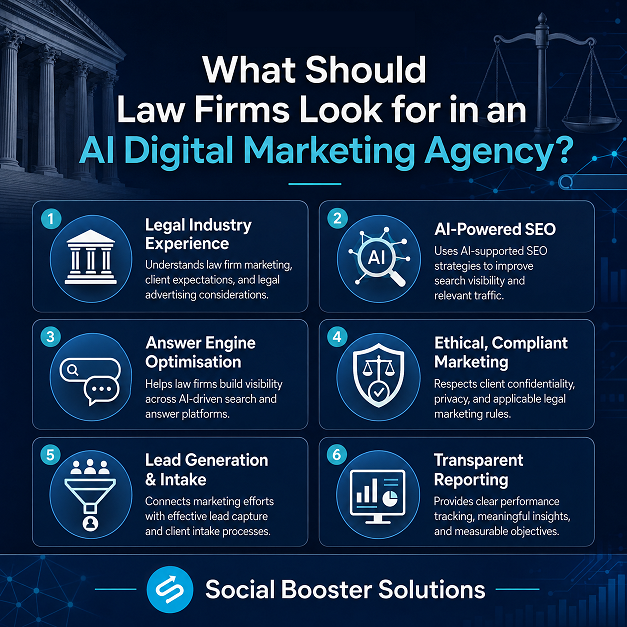
Law firms should choose an AI digital marketing agency that understands the legal industry, uses AI responsibly, builds a strong online presence, and helps turn genuine inquiries into consultations. The right agency should explain its strategy clearly, provide measurable reporting, protect client information, and support the firm’s long-term business goals rather than promise instant rankings or guaranteed cases.
With more people using AI tools to research legal services, attorneys also need to consider how their firm appears in traditional search results, AI-generated answers, and local search listings. A useful agency combines these channels with relevant content, effective advertising, and a reliable client intake process.
Here are the key factors law firms should evaluate before hiring an agency.
1. Look for an agency that understands the legal industry
A law firm has different marketing needs from a restaurant, retail store, or general service business. Legal marketing involves professional credibility, sensitive client information, practice-area knowledge, and advertising rules that vary by jurisdiction.
An agency should understand how people search for legal help, what questions they ask before contacting an attorney, and why trust matters when someone is choosing legal representation.
Ask whether the agency has experience working with your practice area, such as personal injury, family law, criminal defense, immigration, or estate planning. It should also explain how it reviews marketing materials for accuracy and how it accounts for applicable bar advertising requirements.
For example, an advertisement should not imply a guaranteed legal outcome. A blog post should not present general information as individual legal advice. These distinctions matter when creating content that represents a law firm.
What to ask the agency:
- Have you worked with law firms in my practice area?
- How do you account for legal advertising rules and jurisdictional differences?
- Who reviews content for legal accuracy before publication?
- How do you protect information submitted by prospective clients?
A provider should be able to explain its process rather than simply claim that it specializes in legal marketing.
Learn more: How Law Firms Can Automate Marketing With AI Technology
2. Understand how the agency approaches AI and traditional SEO
AI tools are changing how people find and evaluate information, but traditional search engine optimization remains important. A law firm’s marketing strategy should connect technical SEO, helpful content, local visibility, and AI search optimisation instead of treating them as unrelated services.
When evaluating AI digital marketing for law firms, ask how the agency plans to make your firm’s information useful to people and understandable to search systems.
What is ChatGPT SEO for lawyers?
ChatGPT SEO for lawyers generally refers to improving a law firm’s online information so that it can be found, understood, and potentially referenced when people use ChatGPT to research legal topics or legal service providers.
An agency should explain the practical work involved, such as:
- Publishing accurate, well-structured pages about the firm’s services.
- Providing clear information about attorneys, practice areas, and locations.
- Maintaining consistent business information across relevant platforms.
- Creating original answers to genuine client questions.
- Improving the website’s technical accessibility and overall usability.
No agency can guarantee that ChatGPT will mention a particular law firm. AI responses can vary according to the question, available sources, and the system’s retrieval process.
Learn more about ChatGPT optimization for law firms
What is answer engine optimization for law firms?
Answer engine optimization for law firms focuses on making useful information easier for answer-oriented search experiences to interpret and present.
That means writing clear answers, using descriptive headings, explaining legal terms in plain language, and supporting claims with credible sources where appropriate. It also means avoiding vague claims that fail to explain what the firm actually does.
Explore Answer Engine Optimization for Law Firms to understand how this service relates to a firm’s online visibility.
Want to understand how these strategies could fit your practice? Explore Social Booster Solutions and review its legal marketing services.
Read More – AI SEO for Lawyers: What Actually Works in 2026
3. Evaluate the agency’s approach to SGEO
SGEO, or Search Generative Engine Optimization, is a term used by some providers for work aimed at improving a brand’s visibility in generative search experiences.
When considering SGEO for law firms, ask the agency to define exactly what it includes. The label alone does not tell you whether the work involves useful content, technical improvements, local SEO, brand information, or reporting.
A credible plan should identify the pages being improved, the audiences being served, and the evidence used to assess progress. It should not rely on promises that a certain number of AI citations or recommendations will appear.
For instance, a family law firm may need clear pages explaining divorce services, child custody representation, attorney credentials, and the geographic areas it serves. Those pages should answer common questions without making unsupported claims about legal outcomes.
The agency should also explain how it will review content quality and update information when services, laws, or business details change.
4. Check whether the agency creates content that genuinely helps people
A strong legal marketing strategy should answer the questions prospective clients have before they contact an attorney. Content should be written for people first, with search visibility supporting its usefulness rather than replacing it.
Ask how the agency researches topics, checks facts, and incorporates attorney expertise. AI tools may assist with research or drafting, but the agency should have a review process to catch inaccuracies, outdated information, and statements that could mislead readers.
Useful content formats include:
- Explanations of legal processes and terminology.
- Answers to frequently asked questions about a practice area.
- Guides describing what information someone may want to prepare before a consultation.
- Attorney biographies that accurately describe experience and credentials.
- Articles explaining when a person may need to speak with a qualified lawyer.
For legal topics, accuracy is especially important. Content should make clear when laws differ by location, when information may change, and when readers should seek advice about their own circumstances.
An agency should also avoid publishing near-identical articles for every keyword variation. Each page should serve a distinct purpose and provide meaningful value.
Read More – Why E-E-A-T Matters More for Law Firms in AI Results
5. Ask how the agency generates and qualifies leads.
Website traffic is useful, but traffic alone does not tell a law firm whether its marketing is producing meaningful business opportunities. An agency should explain how it attracts relevant prospects and helps the firm manage inquiries after they arrive.
When assessing AI digital marketing for law firms, look for a strategy that connects advertising, landing pages, intake forms, follow-up, and reporting.
What should law firms know about lead generation?
Lead generation strategies for law firms may include search advertising, relevant website content, local SEO, social media campaigns, and other channels suited to the practice area.
However, a lead is not automatically a qualified prospective client. Someone may submit a form for the wrong service, live outside the firm’s service area, or need assistance the firm does not provide.
Ask the agency how it defines a qualified lead and whether the reporting distinguishes between:
- Total inquiries received.
- Relevant inquiries matching the firm’s practice areas.
- Consultations scheduled and attended.
- Matters accepted by the firm.
- Marketing costs associated with each stage.
These measurements help attorneys understand where opportunities are being lost and which channels deserve further investigation.
Review Social Booster Solutions’ services to see which marketing options may be relevant to your firm’s needs.
6. Review the agency’s approach to Funnels for Law Firms
Funnels for Law Firms connect the steps a prospective client takes from first learning about a firm to submitting an inquiry or scheduling a consultation.
A well-planned funnel should make it easy for visitors to understand the firm’s services and take an appropriate next step. It should not pressure people into sharing unnecessary sensitive information or create confusion about whether an attorney-client relationship has been established.
A typical funnel may include an informative landing page, a clear contact form, appointment scheduling, and a process for routing inquiries to the right team member.
Social Booster Solutions describes its SmartCase™ AI Growth Framework as combining lead generation, intake workflows, follow-up sequences, and reporting. Its SmartCase™ AI Growth Framework page explains how these components are intended to work together.
Before choosing a provider, ask for a walkthrough of the proposed workflow. Find out what happens when a lead arrives outside business hours, when a form is incomplete, or when a person requests that the firm stop contacting them.
Review the SmartCase™ AI Growth Framework to learn about its intake, automation, and lead management approach.
Read More – How Legal Marketing Funnels Help Law Firms Get More Cases
7. Make sure privacy, security, and legal ethics are considered
Law firms handle information that can be confidential, sensitive, or subject to professional obligations. AI marketing systems should therefore be evaluated not only for convenience but also for how they collect, store, access, and use information.
Ask the agency:
- What information is collected through forms, chat tools, and advertising campaigns?
- Who can access prospective client information?
- Which third-party platforms process or store the data?
- How are access permissions, retention, and deletion handled?
- How are automated messages reviewed for accuracy and appropriate use?
- What safeguards prevent confidential details from being entered into public AI tools?
The answers should be specific to the actual tools and workflows being proposed. Do not assume that a platform is compliant simply because it uses AI or is marketed to law firms.
The law firm should retain appropriate oversight of legal communications, advertising claims, and decisions that require professional judgment. Its own obligations may depend on the jurisdiction and the nature of the information involved.
For additional context, review the company’s Privacy Policy and PII Policy .
8. Demand clear reporting and realistic expectations.
A reliable agency should explain what it will measure, how often it will report, and what those measurements can and cannot prove.
For AI digital marketing for law firms, useful reporting may cover organic search visibility, website engagement, advertising costs, inquiry quality, booked consultations, and intake performance.
Ask whether the agency can distinguish between activity and business outcomes. For example, an increase in impressions does not necessarily mean an increase in qualified inquiries. Similarly, a rise in leads does not automatically establish that more cases will be retained.
AI search visibility can also be difficult to measure consistently because responses may vary across platforms and prompts. Ask what method the agency uses, how often it checks results, and what limitations apply.
Be cautious of guarantees involving first-place rankings, a fixed number of signed cases, or assured inclusion in AI-generated answers. Marketing performance depends on factors such as competition, budget, website quality, location, practice area, and the firm’s own intake process.
Social Booster Solutions outlines its marketing and advertising options through its AI Advertising services . Review the actual scope and proposed measurements before deciding whether they match your firm’s needs.
Read More – How Law Firms Can Automate Marketing With AI Technology
9. Choose a strategy that fits your firm’s size and goals
A solo attorney may need a different marketing plan from a multi-location law firm with several practice areas and a dedicated intake team.
Before signing an agreement, discuss your firm’s priorities, budget, target locations, staffing capacity, and ability to respond to new inquiries. The agency should explain which services are included, which are optional, how work is approved, and how changes to the plan will be handled.
For example, a firm with a strong website but inconsistent follow-up may need to examine intake processes before investing heavily in more traffic. A firm with limited search visibility may first need technical improvements, useful service pages, and a clearer local presence.
An AI digital marketing for law firms plan should reflect these differences. It should be built around the firm’s actual needs, not a standard package that assumes every practice has the same audience, budget, and sales process.
Questions to ask before hiring an agency
Use this checklist during consultations:
- Does the agency understand my practice area and target market?
- Can it explain its SEO, SGEO, advertising, and AI approach in plain language?
- How does it check content for accuracy and legal advertising concerns?
- What does it count as a qualified lead or successful conversion?
- Which reports will I receive, and how frequently?
- What are the contract terms, deliverables, and additional costs?
- How will my firm maintain control over client information and communications?
The answers should help you understand what the agency will actually do, how success will be evaluated, and what responsibilities remain with your firm.
10. Why consider Social Booster Solutions?
Social Booster Solutions focuses on digital marketing for law firms and offers services including its SmartCase™ AI Growth Framework, website redesign and development, Local & Premium SGEO, social media management, AI-powered intake funnels, data services, advertising, and custom AI infrastructure.
Its service mix may be relevant to firms that want to examine how search visibility, advertising, lead capture, and intake workflows can work together. As with any provider, review the scope, pricing, proposed process, and reporting before making a commitment.
For firms researching AI digital marketing for law firms, the important question is not simply whether an agency uses AI. It is whether the agency can explain how its tools support accurate information, responsible marketing, meaningful inquiries, and a better experience for prospective clients.
Schedule a consultation with Social Booster Solutions to discuss your firm’s marketing goals and the services that may fit your needs.
Final thoughts
Choosing an AI marketing partner requires more than comparing software features or promises of rapid growth. Law firms should look for legal industry knowledge, responsible AI practices, useful content, clear reporting, effective intake processes, and realistic expectations.
The right approach connects the entire client journey: helping people find accurate information, understand the firm’s services, make informed decisions about contacting an attorney, and receive a timely response when they reach out.
Social Booster Solutions provides a range of legal marketing services that firms can review against these requirements. Take time to evaluate the proposed strategy, ask specific questions, and ensure the plan supports your firm’s goals and professional responsibilities.