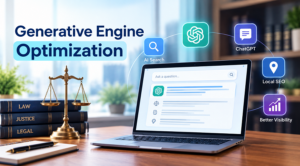


Your law firm may have a well-designed website, positive client reviews, and a strong Google presence, yet still be absent from recommendations generated by ChatGPT, Gemini, Perplexity, and Microsoft Copilot. This can happen because traditional search visibility does not automatically translate into visibility in AI-generated answers. These platforms use different methods to retrieve, evaluate, and present information. Generative engine optimization for law firm websites helps improve how clearly search systems understand your legal services, expertise, location, and online reputation.
For law firms, the goal is not simply to rank for a keyword. It is to make accurate, useful, and trustworthy information about the practice easier for search engines and AI-powered tools to interpret and reference. Understanding the reasons behind low AI visibility is the first step toward fixing it.
1. Your Website Content Does Not Answer Specific Legal Questions
One common reason a law firm is missing from AI-generated recommendations is that its website does not provide direct answers to the questions potential clients actually ask.
People rarely search only for a lawyer’s name. They may ask, “How do I appeal a denied Social Security disability claim?” or “What should I do after a car accident in Tampa?” AI tools may use information from relevant, accessible sources to help answer these questions.
If your website contains only general service descriptions, it may not provide enough useful context to support those answers.
How to improve your legal content
Create pages and articles that answer real questions related to your practice areas. Explain the process, eligibility requirements, common mistakes, important deadlines, and next steps where appropriate. Use clear headings, concise explanations, and relevant examples without promising specific legal outcomes.
For instance, a Social Security disability attorney can publish a helpful guide explaining the difference between an initial application and an appeal. A personal injury law firm can explain what evidence someone may need after an accident.
The content should demonstrate genuine legal knowledge, identify its intended audience, and make it easy for readers to understand the information.
2. Your Law Firm’s Expertise Is Not Clear Enough Online
AI-generated recommendations depend partly on whether available information helps establish that a business is relevant to a particular question. If your website does not clearly communicate your practice areas, attorneys’ qualifications, service locations, and experience, it may be harder for systems to associate your firm with the right legal queries.
This is where generative engine optimization for law firm websites becomes relevant. It focuses on presenting accurate, well-organized information that helps search systems understand what your firm does and whom it serves.
Build stronger trust signals
Make sure your website includes detailed attorney biographies, accurate practice-area pages, a clear contact page, and information about the jurisdictions in which your attorneys are authorized to practice. Explain professional experience using verifiable facts rather than vague claims.
Because legal services can significantly affect people’s lives, content accuracy matters. Articles discussing legal rights, procedures, or deadlines should be reviewed by a qualified legal professional and updated when necessary.
Your firm should also maintain consistent business details across relevant directories and professional profiles. Consistency helps reduce confusion about the firm’s identity and location.
Want to understand why your law firm has limited visibility in AI search results? Contact Social Booster Solutions to discuss your website content, search presence, and opportunities to improve your online visibility.
3. You Rely on Traditional SEO Alone
Traditional search engine optimization remains important, but appearing in conventional search results does not guarantee that your law firm will be mentioned in an AI-generated response.
Google rankings, AI citations, and recommendations inside conversational search tools are related but different outcomes. AI platforms can use search indexes, retrieved webpages, their own ranking systems, and other available information in different ways. Their sources and selection methods can also change.
What is the difference between SEO and SGEO?

SEO helps search engines understand and rank your website for relevant searches. Search Generative Engine Optimization (SGEO), also called generative engine optimization, focuses on improving the likelihood that your content will be understood, retrieved, and used in AI-generated search experiences.
A practical approach combines both. Maintain technically sound pages, create useful legal resources, build relevant authority, and ensure that your information is accessible to search crawlers where platform policies permit.
There is no guaranteed method to make ChatGPT, Gemini, or another AI tool recommend a particular law firm. The objective is to improve the quality and clarity of the information available about your practice.
4. Your Local SEO Signals Are Too Weak
Local relevance matters when someone asks an AI tool to recommend a lawyer in a specific city. A firm may have useful legal content but lack clear location information or consistent local business details.
For example, a practice targeting law firm SEO Tampa should clearly explain the legal services it provides in Tampa and the surrounding areas it genuinely serves. A firm targeting jacksonville law firm SEO agency as a marketing search term should understand that prospective clients and legal businesses may use location-specific phrases differently. Content should reflect the actual service being offered rather than simply repeating keywords.
Similarly, an attorney working with Social Security disability claims may benefit from content built around SEO for social security disability lawyer search intent, including questions about applications, appeals, representation, and local service availability.
Read More: Google Business Profile Optimization for Law Firms
Strengthen your local presence
Keep your Google Business Profile accurate and complete, where eligible. Verify your address or service-area details, business hours, website link, and contact information. Build useful location pages that describe genuine services and local relevance instead of publishing nearly identical pages for every city.
Earn authentic reviews in accordance with applicable professional rules and platform policies. Respond appropriately to reviews without revealing confidential client information.
These steps support local search visibility and may help AI systems connect your practice with relevant geographic questions, although they cannot guarantee inclusion in recommendations.
If your firm serves a specific Florida market, ask Social Booster Solutions about local SEO and SGEO strategies that align your legal services with the questions people ask online.
5. Your Website Is Difficult for Search Engines to Access
Even useful legal content can struggle to gain visibility if search engines cannot crawl important pages or understand how the website is organized. Technical SEO provides the foundation for both conventional search and many AI-assisted discovery experiences.
Common issues include broken internal links, slow-loading pages, incorrect canonical tags, accidental noindex directives, blocked crawling, and duplicate content. Poor mobile usability can also make it harder for visitors to navigate your site.
What should you check?
Review your website using Google Search Console to identify indexing problems, crawl errors, and pages that receive impressions but few clicks. Check your robots.txt file and page-level directives to ensure that important content is accessible to the appropriate crawlers. Add relevant internal links between practice-area pages, attorney profiles, and educational articles.
Structured data, such as appropriate Organization, Legal Service, and Article markup, can help describe your business and content. However, structured data does not guarantee AI citations or special search placement.
A reliable technical foundation makes your website easier to maintain and helps search engines interpret the information you publish.
6. Your Content Is Not Structured for AI Answers
When users ask conversational questions, they often expect a short, direct answer followed by useful details. Content that takes several paragraphs to reach the main point may be less convenient for readers and harder to extract into concise answers.
This is why answer engine optimization for law firms should be part of a practical content strategy.
Make your pages easier to understand
Start important sections with a clear answer, then explain the relevant details. Use descriptive headings, short paragraphs, and FAQs based on genuine client questions. Explain legal terms in plain English and link to authoritative sources when discussing laws, regulations, or official procedures.
For example, an article about disability benefits could begin by explaining who generally qualifies, followed by eligibility factors, application steps, appeal procedures, and links to official Social Security Administration resources.
This format supports readers who need quick answers while still providing the depth required for informed decisions. It can also help search systems interpret the relationship between a question and its answer.
7. Your Firm Has Limited Brand Recognition Across Trusted Sources
Your website is only one source of information about your practice. Professional directories, bar association profiles, credible local publications, relevant legal resources, and consistent business listings can provide additional context about your firm.
If your online presence is limited to your own website, AI systems may have fewer independent sources to help verify your business information and areas of expertise.
Focus on earning legitimate mentions through professional contributions, community involvement, original research, and useful educational resources. Avoid purchasing spammy backlinks or publishing low-quality guest posts solely to manipulate rankings.
Read More: What Should Law Firms Look for in an AI Digital Marketing Agency?
For firms researching SEO agency for attorneys Tampa, the same principle applies when evaluating marketing providers: look for transparent reporting, relevant experience, realistic expectations, and a strategy built around sustainable visibility rather than guaranteed rankings.
Social Booster Solutions can help assess your firm’s online authority, content quality, and local search foundations. Visit Social Booster Solutions to learn more about its digital marketing services.
8. How Can Law Firms Improve ChatGPT and Other AI Search Visibility?
There is no single setting that makes a law firm appear in every AI-generated recommendation. Instead, focus on the factors your firm can control: useful content, accurate business information, technical accessibility, relevant authority, and a clear explanation of your legal services.
A practical generative engine optimization for law firm websites strategy should include regular reviews of these areas rather than relying on keyword placement alone.
For Chatgpt optimization for law firms, start by checking whether your important pages can be accessed by relevant crawlers and whether your content clearly answers common legal questions. Review the AI tools available to your audience and test realistic prompts, such as questions about your practice area and location. Record whether your firm appears, which sources are cited, and whether the information is accurate.
These observations provide useful clues, but individual AI responses can vary by query, location, platform, and time. Do not treat a handful of tests as proof of overall performance.
Read More: How Can Law Firms Get Found When People Ask ChatGPT for a Lawyer?
Where does the SmartCase™ AI Growth Framework fit?
The SmartCase™ AI Growth Framework for Law Firms, offered by Social Booster Solutions as part of its legal marketing positioning, can serve as a strategic approach to connecting content, search visibility, lead generation, and marketing systems.
The practical priority is to connect these activities. Publish useful legal resources, strengthen local SEO, monitor organic traffic, and make it easy for prospective clients to contact your firm. Track measurable outcomes such as qualified inquiries, consultation requests, relevant referral traffic, and organic search performance rather than focusing exclusively on AI mentions.
Frequently Asked Questions
Why does my law firm rank on Google but not appear in ChatGPT?
Google rankings do not automatically determine ChatGPT recommendations. AI responses may use different retrieval methods and sources. Improving content relevance, accessibility, authority, and accurate business information may help, but inclusion is not guaranteed.
Does SGEO replace traditional SEO for law firms?
No. SGEO complements traditional SEO. Technical health, useful content, relevant links, and local visibility remain important foundations for a sustainable search strategy.
How long does it take to improve AI search visibility?
There is no fixed timeline. Results depend on your website’s current condition, competition, content quality, and how different platforms retrieve information. Review progress over time using multiple performance indicators.
Can a law firm guarantee that ChatGPT will recommend it?
No legitimate marketing provider can guarantee that an independent AI platform will recommend a particular firm for every relevant query. Be cautious of promises of guaranteed AI citations or rankings.
Final Thoughts
If your law firm is missing from AI-generated search recommendations, the solution is not simply to add more keywords to your website. Start by making your legal expertise clear, answering client questions thoroughly, strengthening local SEO, fixing technical issues, and building credible online references.
A consistent generative engine optimization for law firm websites strategy can support better visibility across traditional search and emerging AI-powered experiences. Combine these efforts with helpful content, ethical marketing practices, and clear performance tracking.
Social Booster Solutions helps businesses approach SEO, SGEO, AI-powered marketing, and lead generation as connected parts of a digital growth strategy. If you want to assess where your law firm stands and identify practical improvements, contact Social Booster Solutions to discuss your next steps.