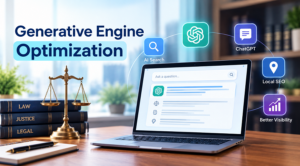

When someone asks ChatGPT, Gemini, Perplexity, or Copilot to recommend a lawyer, your law firm’s website needs to provide clear, trustworthy, and relevant information that search engines and AI tools can understand. ChatGPT Optimization for Law Firms helps improve how your firm’s services, expertise, location, and helpful content are presented across the web, making it easier for potential clients to find and evaluate your practice.
Getting mentioned in an AI-generated answer is not guaranteed. These platforms use different systems to generate responses, and their recommendations can change. However, law firms can take practical steps to strengthen their online presence, answer common legal questions, maintain accurate business information, and build trust with prospective clients.
In this guide, we explain how law firms can improve their visibility in AI-powered search, what content matters, and how Social Booster Solutions can help businesses develop a marketing strategy that supports these goals.
1. Understand How People Search for Lawyers Through ChatGPT
Traditional search often starts with short phrases such as “divorce lawyer near me” or “business attorney in Chicago.” AI-powered search allows people to ask more detailed questions in everyday language.
For example, a potential client might ask:
- “Can an employment lawyer help me if my employer hasn’t paid my overtime?”
- “What should I look for when choosing a personal injury attorney?”
- “Which legal services can help a small business with contract disputes?”
- “How does an estate planning attorney help protect a family’s assets?”
These questions show that people may want explanations, practical next steps, and information about relevant legal services before contacting a law firm.
Your content should address those needs directly. Explain what your firm handles, whom you serve, what the legal process generally involves, and when someone may need professional legal advice.
2. Build a Website That Clearly Explains Your Legal Services
AI systems and traditional search engines need understandable information about your business. A website that clearly describes your legal services can help both people and automated systems understand whether your firm is relevant to a particular question.
Create dedicated practice-area pages
Each major service should have its own useful page rather than being mentioned only in a short list.
For example, a law firm may create separate pages for:
- Business Law Firm Marketing
- Criminal Defense Law Firm Marketing
- Employment Law Firm Marketing
- Estate Planning & Elder Law Firm Marketing
- Family Law and Divorce Law Firm Marketing
- Immigration Law Firm Marketing
- Personal Injury Law Firm Marketing
- Workers Compensation Law Firm Marketing
- Social Security Disability Law Firm Marketing
These are marketing service categories, but the same principle applies to a law firm’s own practice-area pages: explain each legal service individually and make its purpose clear.
A useful page should describe the legal issues addressed, the types of clients served, the relevant jurisdiction, common questions, and the next step for contacting the firm. Avoid vague claims that could apply to every law office.
Want to make your law firm’s services easier to understand online?
Social Booster Solutions can help you plan clear practice-area content that answers the questions prospective clients actually ask. Explore Social Booster Solutions
3. Answer Legal Questions in a Way AI Search Can Understand
One of the most practical ways to support AI search visibility is to publish helpful answers to questions your potential clients are already asking.
This is where ChatGPT Optimization for law firms becomes relevant to your content strategy. Instead of creating pages that focus only on legal keywords, develop content that explains legal topics in a direct, accessible way.
What questions should your law firm answer?
Consider questions related to your practice areas:
| Practice area | Example question to answer |
|---|---|
| Business law | What should a business owner do when a contract is breached? |
| Criminal defense | What happens after someone is arrested for a criminal offense? |
| Employment law | What can an employee do if they experience workplace discrimination? |
| Estate planning | What documents are commonly included in an estate plan? |
| Family law | What factors can affect child custody arrangements? |
| Immigration law | What documents may be needed for an immigration application? |
| Personal injury | What information should someone collect after an accident? |
| Workers’ compensation | What should an employee do after a workplace injury? |
| Social Security disability | What information may help support a disability benefits application? |
These questions are starting points, not substitutes for jurisdiction-specific legal guidance. Your content should explain when laws differ by state or country and when readers should consult a qualified attorney.
If your firm handles criminal defense cases, learn more about how to optimize a criminal defense law firm website for AI search and make your legal content easier for potential clients to understand.
Use a clear question-and-answer structure
A useful legal article can follow this simple format:
- State the direct answer near the beginning.
- Explain the general legal principle in plain language.
- Identify important exceptions or factors that may affect the outcome.
- Explain what information or documents may be relevant.
- Describe when speaking with an attorney may be appropriate.
This structure helps readers find the information they need without navigating lengthy introductions. It also makes the content easier for search systems to interpret.
4. Use Answer Engine Optimization and SGEO Together

Traditional SEO remains important, but businesses are also paying attention to how their information appears in AI-generated answers and conversational search experiences.
Answer Engine Optimization for Law Firms focuses on making content useful and understandable for systems that provide direct answers to questions. This includes clear explanations, relevant headings, accurate facts, and well-organized information.
SGEO for Law Firms, or Search Generative Experience Optimization, is another term used for strategies aimed at improving visibility in generative search experiences.
These approaches overlap with established SEO practices. They should support a useful website rather than replace technical SEO, content quality, or a strong reputation.
What should your firm work on?
- Write clear answers to common legal questions.
- Use descriptive headings that accurately reflect the page content.
- Keep attorney biographies, practice areas, locations, and business details accurate.
- Add relevant internal links between practice-area pages and educational articles.
- Use appropriate structured data when it accurately represents the visible content.
- Make sure important pages can be crawled, indexed, and accessed on mobile devices.
- Review older articles for outdated laws, procedures, statistics, and references.
There is no special markup that guarantees a ChatGPT recommendation. Structured data can help describe a page, but it does not guarantee that an AI platform will cite or recommend a firm.
For a more detailed look at practical optimization steps, read our guide on how lawyers can rank in AI answers step by step .
5. Strengthen Your Law Firm’s Credibility and Online Reputation
Legal services involve important decisions, so readers need reliable information when evaluating an attorney. Your website should make it easy to understand the firm’s experience, practice areas, qualifications, and professional background.
Show who is responsible for the information
Consider including:
- Attorney names, professional biographies, and relevant qualifications.
- Accurate descriptions of practice areas and jurisdictions served.
- Author or reviewer information for legal educational articles.
- Publication and review dates where appropriate.
- Citations to relevant statutes, court resources, and official government guidance.
- Clear explanations of limitations, exceptions, and when legal advice is necessary.
Avoid unsupported statements such as “the best lawyer in the city” or guaranteed case outcomes. Any testimonials, awards, or case results should be accurate, appropriately presented, and consistent with applicable professional advertising rules.
To understand how experience, expertise, authority, and trust relate to legal content, read why E-E-A-T matters for law firms in AI results .
Keep business information consistent
Your firm’s name, address, website, attorney information, and contact details should be consistent across its website and legitimate business profiles.
Accurate local information can help people confirm that they have found the right firm. It also reduces confusion when a potential client moves between search results, directories, maps, and your website.
6. Make Local SEO Part of Your AI Search Strategy
Many people want a lawyer who serves their city, county, or state. A firm should therefore explain where it practices and which jurisdictions it is authorized to serve.
For example, a family law firm might publish useful information about divorce procedures in the relevant state, while a business law firm could explain contract issues that commonly arise for businesses operating in its service area.
Local SEO for law firms can include:
- Maintaining an accurate Google Business Profile.
- Creating useful location pages for genuine office locations or service areas.
- Including relevant geographic details naturally in practice-area content.
- Providing accurate office hours and contact information.
- Encouraging clients to leave honest reviews without offering prohibited incentives.
- Monitoring and correcting inaccurate directory listings.
Avoid creating dozens of nearly identical city pages that offer little value. Each location page should contain genuinely useful information and accurately reflect the firm’s presence and service coverage.
Need a clearer local visibility strategy for your law firm?
Social Booster Solutions can help identify opportunities to improve your practice-area content, location information, and overall search presence. Get Started with Social Booster Solutions
7. Use Social Media to Support Your Law Firm’s Visibility
Social media can help a law firm share educational information, maintain a recognizable brand, and direct interested readers to useful website resources.
However, social engagement does not automatically translate into AI recommendations. Social media should be part of a broader marketing plan, not a substitute for a useful website, accurate legal information, and a credible professional reputation.
What should law firms share on social media?
A practical content calendar might include:
- Short explanations of common legal questions.
- Links to newly published practice-area articles.
- General reminders about legal deadlines, with appropriate jurisdictional context.
- Introductions to attorneys and explanations of their practice areas.
- Educational videos that explain legal procedures in accessible language.
- Answers to frequently asked questions, without revealing confidential client information.
Social media management for law firms should also account for professional advertising rules, client confidentiality, privacy requirements, and the risks of giving individualized legal advice through public comments or direct messages.
A consistent publishing schedule can help a firm maintain communication with its audience while giving people useful resources to revisit and share.
Need ideas for your next social media posts? Explore what law firms should post on social media to get real inquiries .
8. Consider AI Solutions for Law Firms Without Losing the Human Touch
AI tools can support certain marketing and administrative tasks, but law firms should use them carefully. Legal content needs human oversight because incorrect or outdated information can mislead readers and damage trust.
AI Solutions for Law Firms may support activities such as organizing frequently asked questions, assisting with content outlines, summarizing approved internal materials, and helping teams manage routine marketing workflows.
For example, a marketing team could use an AI tool to group common questions about estate planning into topics for future articles. An attorney or qualified reviewer should then verify the legal explanations before publication.
Other potential uses include:
- Drafting initial content outlines for human review.
- Organizing website inquiries into appropriate intake categories.
- Helping identify gaps in existing educational content.
- Supporting reporting and analysis of marketing performance.
- Assisting with routine administrative workflows under suitable privacy controls.
Do not place confidential client information into AI systems without confirming that the tool and its use comply with the firm’s confidentiality, privacy, and security obligations.
9. Measure Whether Your Marketing Efforts Are Working
AI search visibility can be difficult to measure because platforms may provide different answers to different users, and not every platform offers detailed referral or citation reporting.
Rather than relying on a single AI mention, track a combination of meaningful website, search, and business indicators.
| Metric | What it helps you understand |
|---|---|
| Organic search traffic | Whether people are reaching the website through unpaid search results. |
| Search impressions and clicks | How pages appear and perform for relevant search queries. |
| Qualified inquiries | Whether marketing is attracting people with relevant legal needs. |
| Landing-page engagement | Whether visitors are finding useful information and taking next steps. |
| Referral traffic | Whether identifiable external websites and platforms send visitors. |
| AI citations and mentions | Whether your firm or content appears in selected AI responses, where observable. |
Review these metrics over time and compare them with the work completed. Keep in mind that traffic, rankings, and inquiries can be affected by competition, location, seasonality, changes in search systems, and other factors.
10. Create a Practical Plan for ChatGPT Search Visibility
A useful starting point for ChatGPT Optimization for law firms is to review your current website and identify the most important gaps before investing in new content or tools.
Law Firm AI Search Readiness Checklist
Your progress
- Review practice-area pages for clarity, accuracy, and completeness.
- Identify common questions prospective clients ask about each legal service.
- Update attorney biographies, jurisdictions, office details, and business profiles.
- Check technical SEO, mobile usability, indexing, and internal links.
- Review legal articles for accuracy, sources, and outdated information.
- Plan useful educational content for relevant search questions.
- Review social media content and professional advertising compliance.
- Establish a baseline for organic traffic, inquiries, and observable AI mentions.
A staged plan makes it easier to prioritize improvements, assign responsibilities, and review progress without treating AI search optimization as a one-time task.
How Social Booster Solutions Can Help Your Law Firm
Social Booster Solutions provides digital marketing services for businesses, including law firms that want to improve their online presence and attract relevant inquiries.
Our approach to ChatGPT Optimization for law firms can be incorporated into a broader marketing strategy that considers website content, SEO, local visibility, social media, and the ways prospective clients search for legal services.
Depending on your firm’s needs, this work may include:
- Reviewing website content and identifying opportunities to answer relevant legal questions.
- Improving practice-area pages and internal linking.
- Supporting Answer Engine Optimization and SGEO strategies.
- Planning educational content and social media activities.
- Reviewing measurable marketing indicators to understand progress.
The objective is to make your firm’s information clearer, more useful, and easier for prospective clients to evaluate. No marketing approach can guarantee inclusion in ChatGPT responses or a specific number of leads.
Ready to improve how people find your law firm online?
Speak with Social Booster Solutions about your firm’s website, content, and digital marketing priorities. Book a Marketing Consultation
Final Thoughts
When people ask ChatGPT or another AI tool for a lawyer, they need relevant information they can understand and evaluate. Law firms can support their online visibility by maintaining accurate business details, publishing helpful legal content, explaining their services clearly, and building a credible online presence.
ChatGPT Optimization for law firms should be treated as an ongoing part of digital marketing rather than a shortcut to guaranteed recommendations. Strong foundational SEO, useful content, professional oversight, and consistent business information remain important.
Social Booster Solutions can help your firm plan and manage these activities as part of its wider business law firm marketing strategy.