


Law firms need more than website traffic to grow. They need the right people to find the firm, understand its services, trust its attorneys, and take the next step. The SmartCase™ AI Growth Framework for Law Firms is designed around that complete journey. Instead of treating SEO, advertising, website performance, content, and lead generation as separate activities, the framework connects them into one growth system.
For a law firm, that means answering important questions at every stage: How do potential clients find the firm? What information do they need before contacting an attorney? How can the website turn visits into inquiries? How can the firm remain visible when people search through Google, ChatGPT, Gemini, Perplexity, Copilot, and other answer-focused platforms?
The goal is not simply to generate more clicks. It is to create a clearer path from search to qualified conversation.
What Is the SmartCase Framework for Law Firms?
The SmartCase™ AI Growth Framework for Law Firms is a connected digital growth approach that brings together search visibility, content, website conversion, advertising, lead management, and data.
Think of it as a system with several connected parts rather than one marketing tactic.
A potential client might first see a law firm’s website through a Google search. Another person may ask an AI search tool a question about their legal situation. Someone else may click a social media advertisement. Each person enters the firm’s marketing system differently, but the experience should lead toward the same outcome: useful information, confidence in the firm, and an easy way to make contact.
This is where a connected growth framework can be useful.
The SmartCase™ AI Growth Framework for Law Firms is a connected digital growth approach that brings together search visibility, content, website conversion, advertising, lead management, and data. For a deeper look at how the framework is structured, read SmartCase: The AI Growth Framework Built for Law Firms.
Why Law Firm Marketing Has Changed
People no longer search for legal services in only one way.
A prospective client may type:
- “personal injury lawyer near me”
- “How long do I have to file a car accident claim?”
- “What should I do after being arrested?”
- “Do I need a lawyer for a divorce?”
- “Best criminal defense attorney in Miami”
- “Can I sue if I was injured at work?”
They may also ask those questions conversationally through ChatGPT, Gemini, Perplexity, or Copilot.
That creates a larger opportunity for law firms, but it also raises the standard for website content. A page that only repeats a service name may not answer the real question behind a search.
Current Google guidance continues to emphasize useful, original, people-first content rather than content created mainly to manipulate rankings. Google also states that its spam policies apply to generative AI experiences in Search.
Want to see how this approach could fit your law firm’s current website and marketing? Contact Social Booster Solutions to discuss your growth goals.
How the SmartCase System Works
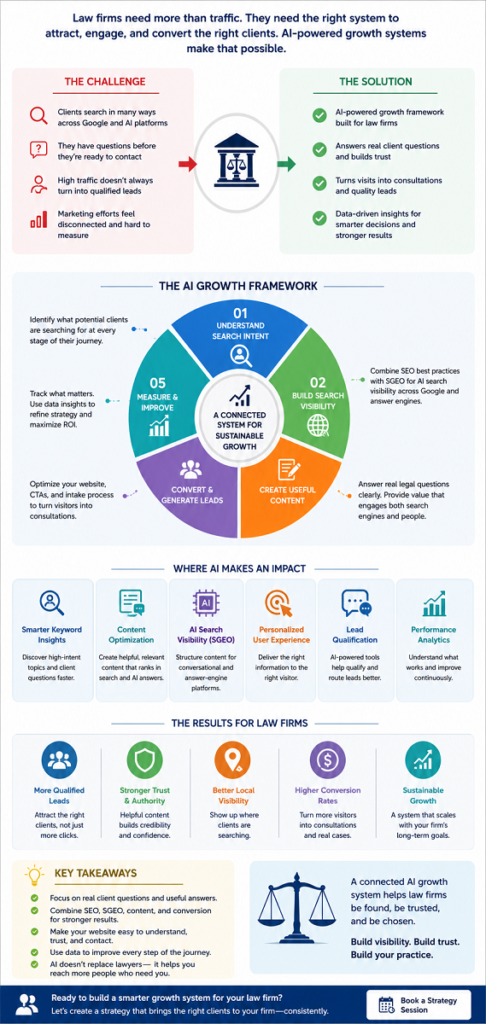
The SmartCase™ AI Growth Framework for Law Firms can be understood through five connected stages.
1. Understand Search Intent
The first step is figuring out what potential clients actually want to know.
Someone searching “personal injury lawyer” has a different intent from someone searching “what happens after a rear-end accident” or “how much does a personal injury lawyer cost?”
Good law firm marketing considers these different questions.
Content can then be organized around informational searches, local searches, service searches, comparison searches, and high-intent searches.
This creates a website that answers real client questions instead of simply publishing pages for keywords.
2. Build Search Visibility
Traditional SEO still matters.
Technical website performance, relevant content, internal linking, local signals, useful page titles, structured information, and authoritative references all contribute to helping search engines understand a law firm’s website.
But search behavior is expanding.
SGEO for Law Firms focuses on making information useful and understandable within generative search experiences. That means writing clear answers, establishing context, covering related questions, and making important facts easy to identify.
This does not mean abandoning SEO. Google specifically notes that established SEO practices remain relevant for success in its generative Search features.
3. Create Content That Answers Real Legal Questions
A strong law firm content strategy starts with the questions clients ask before they contact an attorney.
For example, a personal injury firm could explain:
- What should you do immediately after an accident?
- When should you speak with an attorney?
- What evidence can support a claim?
- How does the insurance process work?
- What damages may be available?
- What can affect a personal injury case?
This type of content can support both traditional search and conversational search.
It also gives attorneys an opportunity to demonstrate knowledge without making unrealistic promises about outcomes.
What Is ChatGPT SEO for Lawyers?
ChatGPT SEO for lawyers is commonly used to describe efforts to make a law firm’s information easier for conversational search systems to understand and potentially reference.
There is no magic formula that guarantees that ChatGPT or another platform will recommend a particular law firm.
Instead, the practical approach is to publish accurate, useful, clearly organized information that addresses genuine questions.
For example, instead of creating a page that repeatedly uses “divorce lawyer,” a firm could explain the divorce process, common legal questions, relevant considerations, and when professional legal advice may be appropriate.
That creates useful information for people first.
It can also give search and answer systems more meaningful information to interpret.
Instead, the practical approach is to publish accurate, useful, clearly organized information that addresses genuine questions. For a practical walkthrough, see How Lawyers Can Rank in AI Answers: Step by Step.
How Answer Engine Optimization Fits In
Answer engine optimization for law firms focuses on the way people increasingly seek direct answers rather than simply a list of websites.
A traditional search may lead someone to a search results page. An answer-focused search may summarize information and provide sources.
That makes clarity important.
A useful page should answer the main question quickly, then provide supporting details.
For example:
Question: What should I do after a car accident?
Seek medical attention when necessary, document the accident, preserve relevant evidence, notify the appropriate parties, and consider speaking with a qualified attorney before making important decisions about a potential claim.
The page can then explain each step in greater detail.
This answer-first format is useful for readers because they do not have to search through several paragraphs before finding the basic information.
Turning Search Traffic Into Law Firm Leads
Visibility alone does not create a successful marketing program.
The next step is conversion.
A law firm’s website should make it easy for a visitor to understand:
- What type of legal matter the firm handles.
- Who the firm serves.
- What geographic areas it covers.
- Why someone should consider contacting the firm.
- What happens after submitting an inquiry.
- How to begin the conversation.
This is where lead generation law firms need a stronger connection between marketing and intake.
A clear call to action, simple intake process, mobile-friendly design, and helpful service pages can reduce that friction. You can also read How Legal Marketing Funnels Help Law Firms Get More Cases to learn how the journey from visitor to potential client can be structured.
A visitor who reads three useful articles but cannot easily find a contact option may leave without taking action.
A clear call to action, simple intake process, mobile-friendly design, and helpful service pages can reduce that friction.
If your website gets visitors but too few inquiries, ask Social Booster Solutions to review the path from search visit to consultation request.
Where Data Fits Into the Framework
Marketing decisions should not rely entirely on assumptions.
A connected growth system can examine information such as:
- Which pages attract qualified visitors
- Which search topics generate engagement
- Which campaigns produce inquiries
- Which landing pages convert better
- Where visitors leave the website
- Which locations generate demand
- Which types of leads become meaningful opportunities
The purpose of collecting this information is not to create complicated reports.
It is to answer practical questions.
For example: If one practice-area page receives substantial traffic but generates very few inquiries, the problem may not be visibility. The page may need clearer information, stronger trust signals, better calls to action, or a simpler contact process.
What Makes the Framework Different From Basic SEO?
Basic SEO often focuses heavily on rankings and traffic.
Those metrics matter, but a law firm ultimately needs qualified conversations and clients.
The SmartCase™ AI Growth Framework for Law Firms connects visibility with the rest of the client journey.
That means considering:
Search → Content → Website → Trust → Inquiry → Intake → Measurement
Each stage influences the next.
If search visibility improves but the website is confusing, growth can stall.
If the website converts well but the firm attracts irrelevant traffic, the intake team may receive poor-quality inquiries.
If advertising generates leads but the intake process is slow, potential clients may move elsewhere.
The system needs to work as a whole.
How Law Firms Can Prepare for AI Search
Law firms do not need to rewrite their entire marketing strategy around every new search platform.
A better approach is to strengthen the fundamentals while making content easier to understand.
Start with questions real clients ask. Provide direct answers. Explain legal concepts in plain language. Show who is providing the information. Keep practice-area and location information accurate. Build useful supporting content instead of publishing dozens of pages with slightly different keywords.
Google’s current guidance also warns against scaled content created primarily to manipulate rankings, regardless of whether automation or generative tools were used to produce it.
That makes quality and usefulness more important than simply increasing the number of pages.
Start with questions real clients ask. Provide direct answers. Explain legal concepts in plain language. Show who is providing the information. For more on building trust and credibility in AI-driven search, read Why E-E-A-T Matters More for Law Firms in AI Results.
Is the SmartCase Framework Right for Every Law Firm?
Not every firm needs the same marketing mix.
A personal injury firm may place significant emphasis on local search, educational content, paid advertising, intake speed, and location-based visibility.
A family law firm may need content around highly specific client questions and a strong trust-building website experience.
A criminal defense firm may need clear information that helps people understand what to do when facing an urgent legal problem.
The strategy should follow the firm’s practice areas, market, competition, audience, and business objectives.
There is no single marketing channel that guarantees growth.
Final Takeaway
The SmartCase™ AI Growth Framework for Law Firms is best viewed as a connected system for helping law firms become easier to find, easier to understand, and easier to contact.
SEO remains important. Content remains important. Local visibility remains important. But today’s search environment also requires law firms to think about conversational questions, answer-focused search, website experience, lead quality, and measurable business outcomes.
For firms working on AI digital marketing for law firms, the priority should not be producing more content simply because more content is possible. The priority should be creating information that genuinely helps potential clients, building trust, and making the next step clear.
Social Booster Solutions helps law firms connect these pieces through a practical digital growth strategy focused on visibility, engagement, and lead generation.
Ready to review your law firm’s digital growth system? Contact Social Booster Solutions and start a conversation about your next steps.